Vigie
Unified monitoring for my web projects — cookieless analytics, uptime checks, scheduled-job tracking and a public status page.
- year
- 2026
- role
- Full-stack design and development
- status
- Live
- front
- Vue 3, TypeScript
- back
- AdonisJS, MCP
- data
- PostgreSQL, Redis
Context
The problem
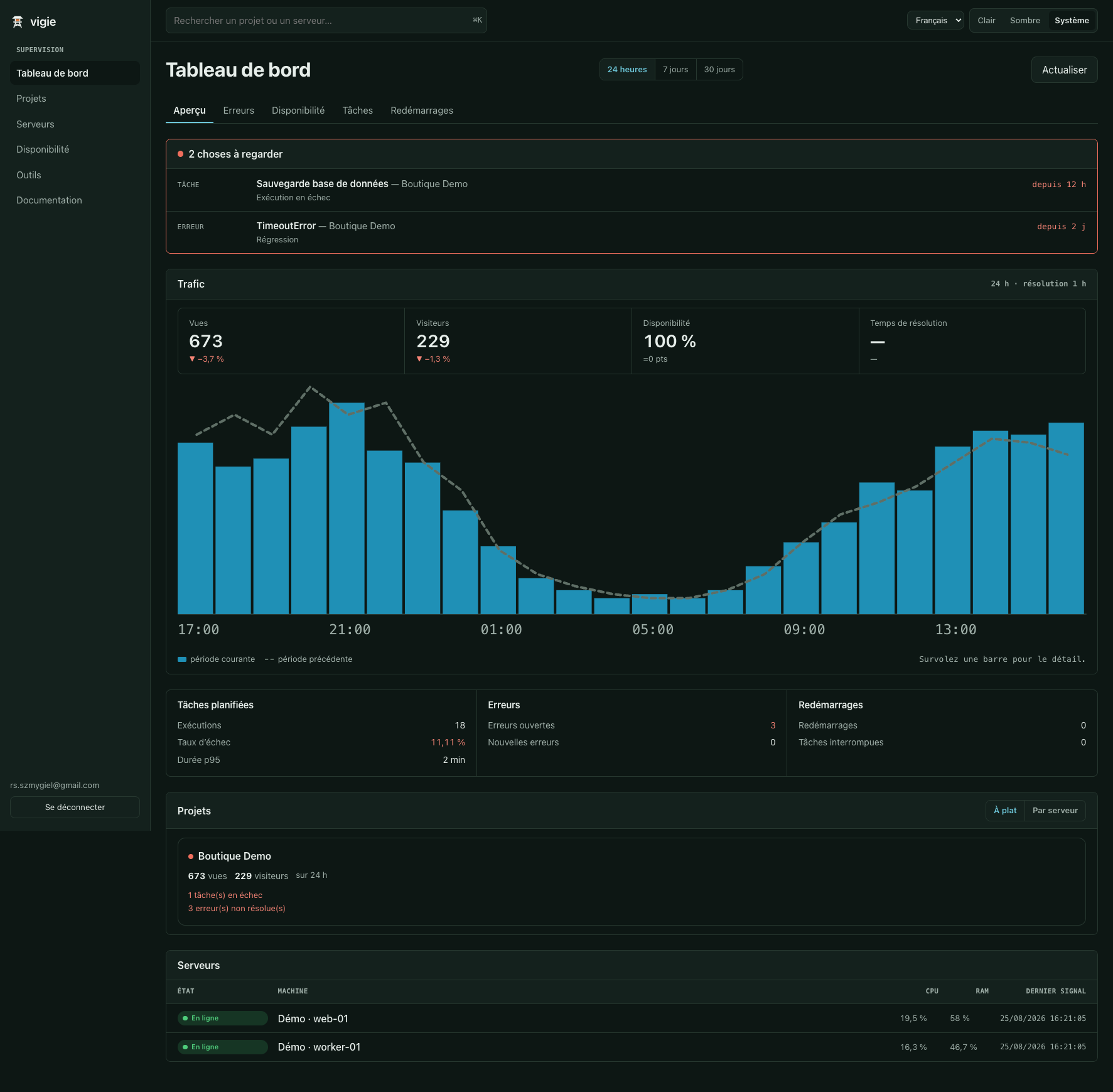
I had a dozen projects online and no overall view: did last night's cron run? Is the API still answering? How many visitors this week? Every answer meant logging into a different server.
Plugging a third-party service into each project would have multiplied the accounts, the costs and the cookie banners. I preferred to build the single tool I was missing.
What Vigie does
- Visit analytics with no cookie and no persistent identifier — no consent banner required
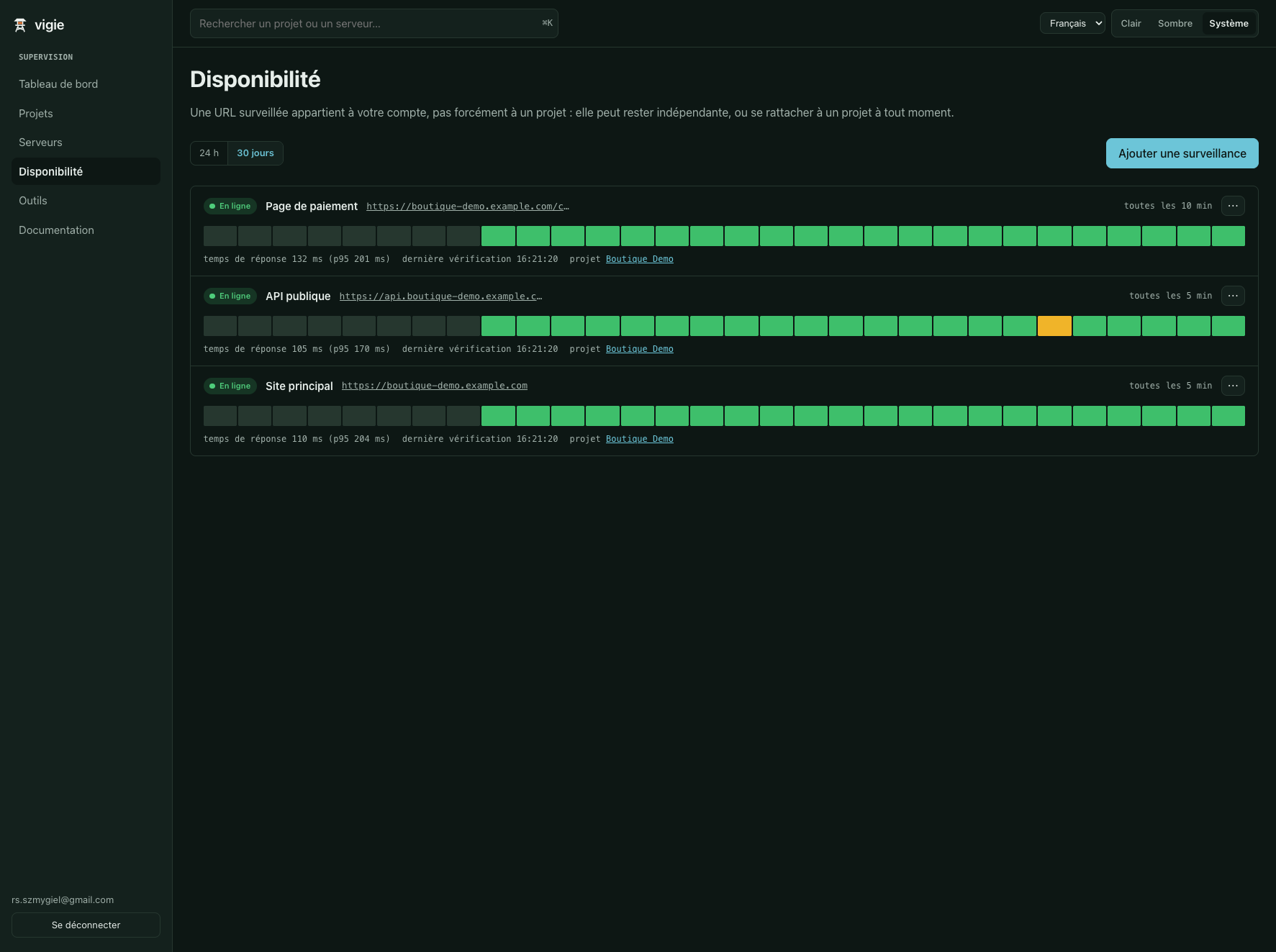
- Uptime monitoring: regular HTTP probes with history and uptime calculation
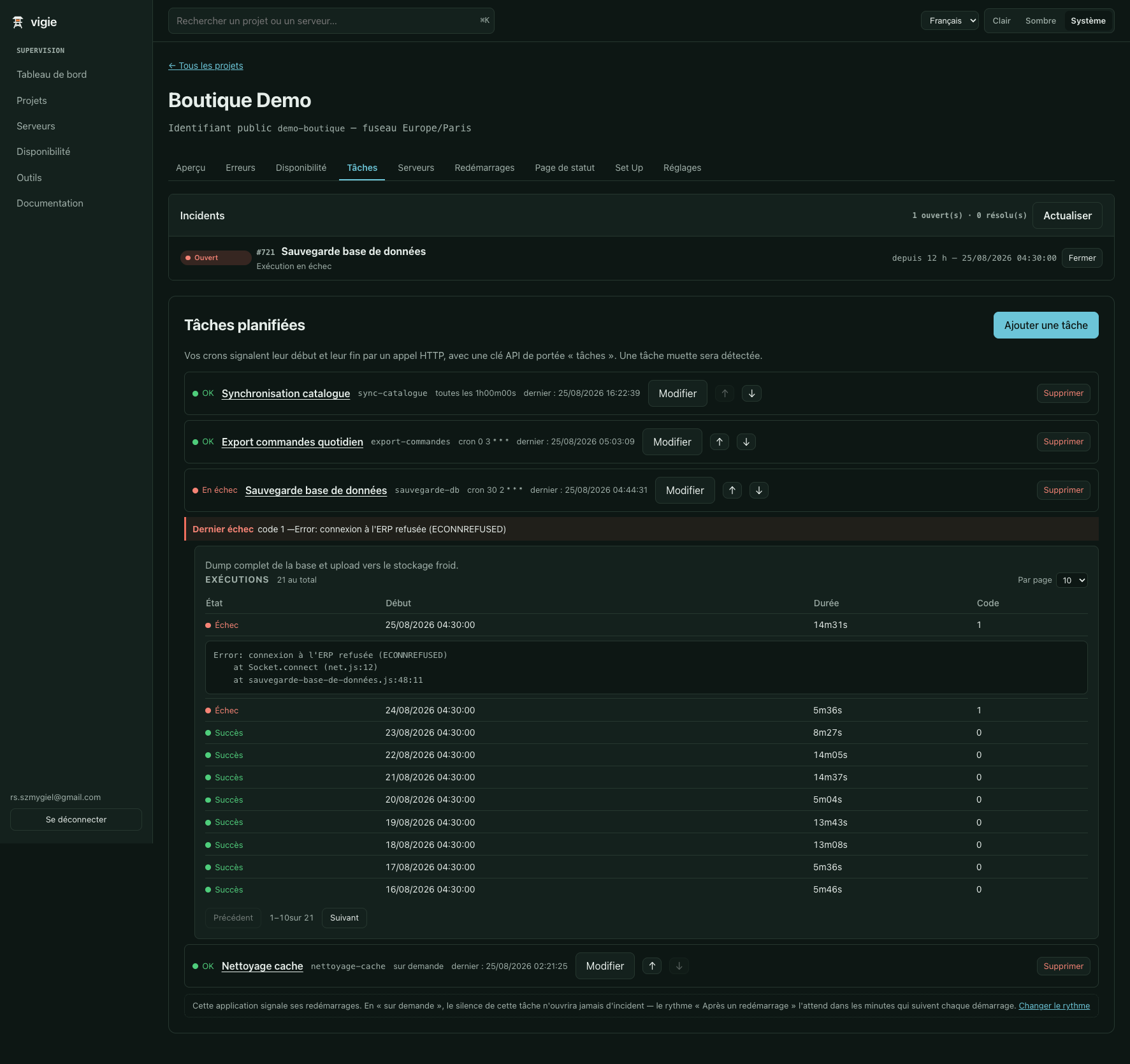
- Scheduled-job supervision: a cron that hasn't checked in within its window raises an alert
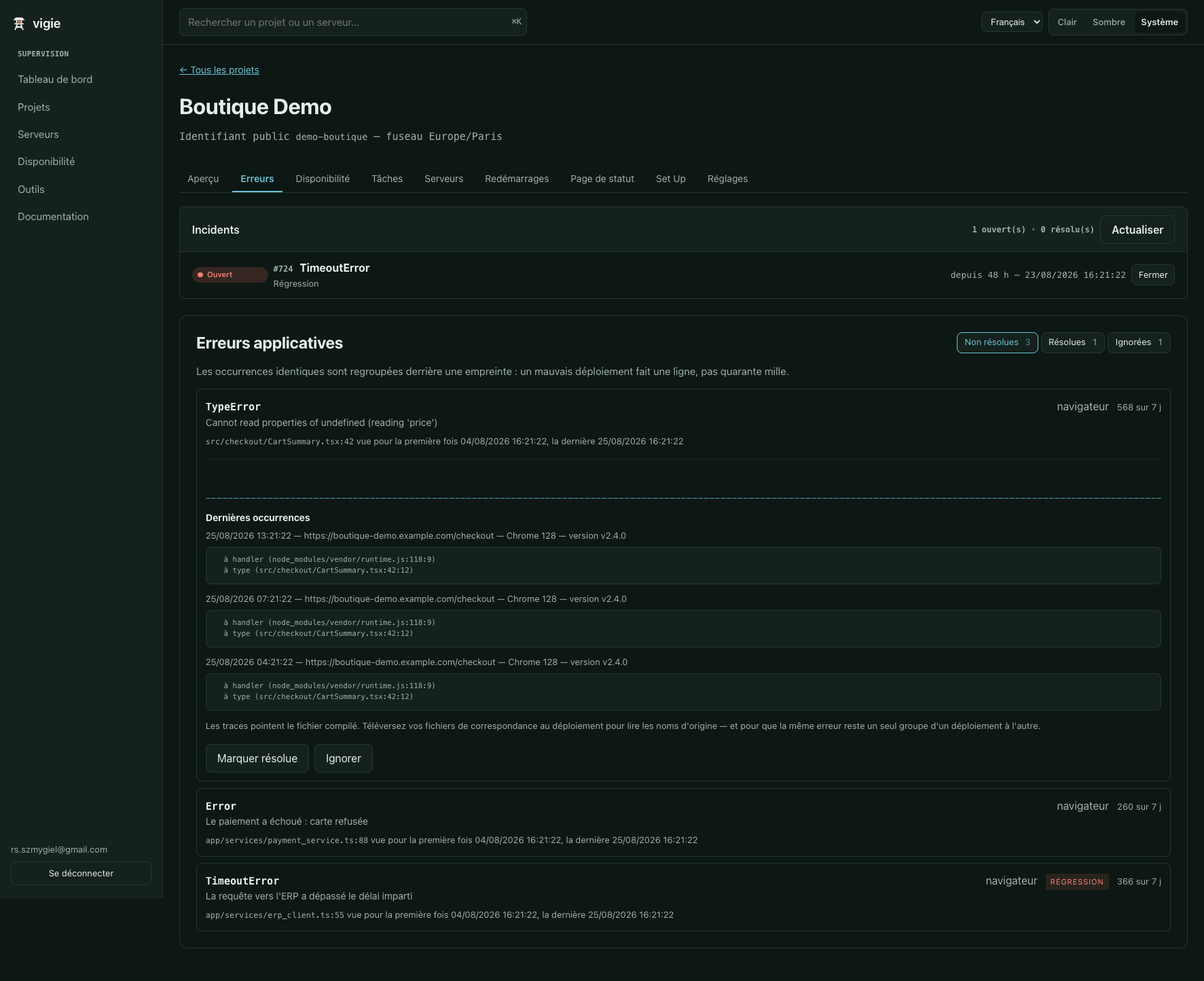
- Error tracking for the application errors reported by the connected projects
- A public status page, fed by the same data as the internal dashboard
Every monitored project has its own API key, and never sees another project's data.
Architecture
| Layer | Choice |
|---|---|
| API | AdonisJS v6, TypeScript, Lucid |
| Database | PostgreSQL 17 |
| Interface | Vue 3, Vite, Pinia, TypeScript |
| Deployment | Docker Compose on a VPS, Caddy in front, GitHub Actions on main |
Everything runs in containers — postgres, redis, api, worker, web —
with no Node required on the host machine. The worker handles probes and
rollups outside the request cycle, which keeps the API responsive no matter how
many projects are being monitored.
The client-side agent
Collecting means putting code inside someone else's page: a bug here doesn't degrade Vigie, it degrades the site being monitored. So the script stays under two kilobytes, with no cookie and no browser fingerprint — and the budget is checked at build time, so the build fails rather than shipping something heavier.
It wraps pushState and replaceState to catch navigations in a single-page
app, then restores the original methods: nothing is permanently altered for the
host application. A @vigie/js plugin hooks straight into the Vue 3 router
instead of guessing from history events.
An MCP server, to stay in the editor
What's broken? Is this error new? Did last night's cron run? Vigie exposes six read-only tools over MCP to answer those questions without opening the dashboard.
Two deliberate choices: no writes at all — an assistant that reads gets the
diagnosis wrong, an assistant that writes gets production wrong; and internal
codes translated on the way out, cause: "silent agent" rather than
reason: 5, because a model facing an unknown code doesn't stop, it guesses.
What I took away
The hard part wasn't collection but retention: keeping years of measurement points without blowing up the database. The answer was progressive rollup — fine-grained data ages into hourly averages, then daily ones.
Architecture
01 · API
AdonisJS v6, TypeScript, Lucid — business logic and endpoints.
02 · Data
PostgreSQL 17, progressive rollup (fine → hourly → daily) to keep retention affordable.
03 · Interface
Vue 3, Vite, Pinia — dashboard and public status page.
04 · Exposure
Docker Compose on a VPS (Caddy, GitHub Actions), plus a read-only MCP server to query monitoring from the editor.
Interface
Next project
Pyro Radar